Construction Safety Program Template: A Practical Guide
Learn the core sections of a construction safety program template, how to adapt it to your trades and crew, and how to keep it current on site.

The International Labour Organization's 2005 global estimate put construction at at least 60,000 fatal site accidents a year, roughly one death every ten minutes, and about 17% of all fatal workplace accidents, or one in six (ILO). The number matters because the fatal work repeats: edges, openings, ladders, energized equipment, struck-by zones.
Yet the document meant to control that work often arrives at nine the night before mobilization. Company name in, logo on, uploaded to the general contractor's portal by morning. The file was built for submission.
A construction safety program template earns its keep when each section has a named owner and leaves evidence that the control was applied on the day. That design changes what belongs on the page.
Why Generic Safety Templates Fall Short
Picture the download. A four-person HVAC crew is replacing rooftop units on a three-story commercial building. The template they adapted the night before describes confined space entry, a critical crane lift and a shored trench. None of those activities will happen. The unit changeout, the roof edge and the ladder access will.
Two failure modes follow from that mismatch, and both are expensive.
- Irrelevant boilerplate trains crews to ignore the document. When most pages describe work the crew never does, signing becomes the ritual and reading becomes optional. The plan gets filed, not used, and the first time anyone opens it again is after an incident.
- Missing task-specific hazards leave real risks uncontrolled. Roof edges, ladder setup, curb transitions, electrical disconnects and hot refrigerant lines all belong on that job's page. If they aren't there, the crew improvises, and improvisation is where the injuries live.
A usable template has to do three things at once. It gives the crew something they can work from at the tailgate meeting, it gives the general contractor a document that survives a review, and it matches the company's trades and the state rules that apply to them.
The build order that works is core sections first, then hazard selection driven by what kills people, then trade and state adaptation, then the hazard records a foreman carries, then the change process that keeps the whole thing current after mobilization.
One self-test applies today. Ask a foreman to point at every task on tomorrow's list, name the hazard attached to it and the control that addresses it. If they can't finish the list without hunting, the template isn't finished.
The Core Sections Every Template Needs
A working template is a set of connected sections, each answering a different question and each leaving a record behind.
| Section | Purpose | What it should hold | Example entry |
|---|---|---|---|
| Responsibilities | Names who controls each hazard | Owner per control, named competent person, supervisors | Foreman stops work and reports a defective guardrail |
| Training | Shows workers were taught the controls | Training roster, toolbox talk records, certifications | Sign-in sheet for fall protection training |
| Task hazard analysis | Links each task to its hazards and controls | Work steps, hazards, controls, responsible party | Rooftop unit replacement: fall from edge, controlled with guardrails and warning line |
| Emergency procedures | Sets the response before an incident | Site emergency information, nearest medical facility, assembly point | Heat illness case escalated to supervisor with authority to pause work |
| Inspections | Confirms controls are in place | Inspection log, frequency, responsible person | Daily scaffold inspection before crew uses it |
| Incident reporting | Captures events and near misses | Incident report form, investigation steps, corrective action | Near miss logged and reviewed at the weekly meeting |
| Revision log and acknowledgment | Shows the current version and crew sign-off | Version, date, approver, crew signatures | Revision 3 signed by crew after a ladder change |
A complete company program built on this structure typically runs 20 to 50 pages, and most of that is short records rather than prose. A full site-specific plan commonly carries 19 sections, from project information and a safety policy through training, a crane and rigging lift plan, an emergency action plan and approval signatures. Expect the page count to sit in the forms, not the paragraphs.
Competent person, defined: someone trained to identify existing and predictable hazards and authorized to take prompt corrective action, including stopping work.
Name a backup for every shift. Inspections and stop-work decisions lapse at the worst moment when the only qualified person is off site or in a meeting.
The section that changes with every job
The task hazard analysis is the part that moves. Responsibilities, training structure and emergency contacts stay stable across projects. The task list doesn't, because a plumbing crew doing underground rough-in and an HVAC crew doing a rooftop changeout share almost no hazards.
Spend your adaptation time there. A template with a strong task hazard analysis and thin prose elsewhere will outperform a fat binder with a generic task list every time.
Hazards That Should Drive Your Template Content
Weight the content toward what kills people. The Occupational Safety and Health Administration's fall prevention guide identifies four dominant construction hazards, falls, struck-by incidents, caught-in or caught-between incidents, and electrocution, and reports that these four categories accounted for 59% of construction worker deaths in 2009. Falls alone represented 34% of construction fatalities, and nearly half, 48%, of all fatal falls in private industry involved construction workers.
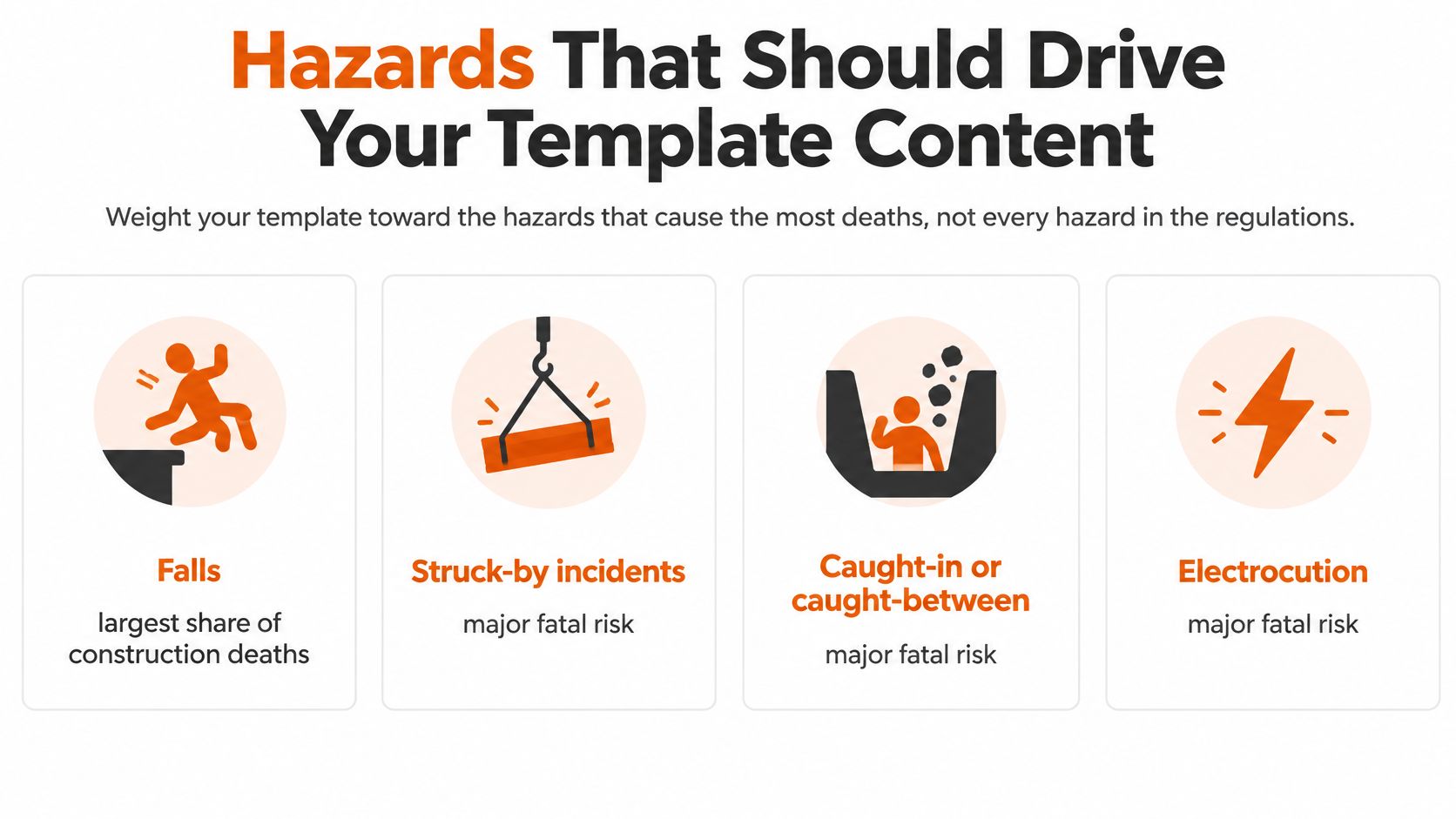
Where fatal falls actually start
The same OSHA analysis of 1992 to 2005 fatal falls breaks the exposure down by origin, which is more useful than the headline number because it tells you which tasks to write first.
| Fall source | Share of fatal falls | Typical trade context | Control to write in |
|---|---|---|---|
| Roofs | About one-third | Rooftop HVAC units, plumbing vents, roof openings | Guardrails, warning lines, roof access controls |
| Scaffolds or staging | 18% | Overhead piping, duct and electrical rough-in | Inspected scaffolds, guardrails, competent person checks |
| Ladders | 16% | Plumbing and electrical rough-in, equipment hookups | Ladder selection, secure setup, three points of contact |
| Structural steel or girders | 8% | Equipment support steel, connectors | Fall arrest, controlled access, connector procedures |
| Other sources | Remaining share, about a quarter | Openings, floor edges, lifts | Task-specific controls from the hazard analysis |
Map those rows onto your own work. A rooftop unit changeout is roof work. A electrical rough-in above a ceiling grid is often ladder work. Overhead piping and duct runs mean scaffolds or lifts. Equipment support steel means connectors and fall arrest.
Gap check: list every hazard category a selected task touches, then confirm the template carries a control for each one. A category with no control is a gap, not a blank left for the site.
Heat and other changing exposures belong in the revision process rather than in this static list, because they shift within a shift.
How to Adapt the Template to Your Trades and Crew
Adaptation is a sequence, and each step exists because skipping it creates a specific failure.
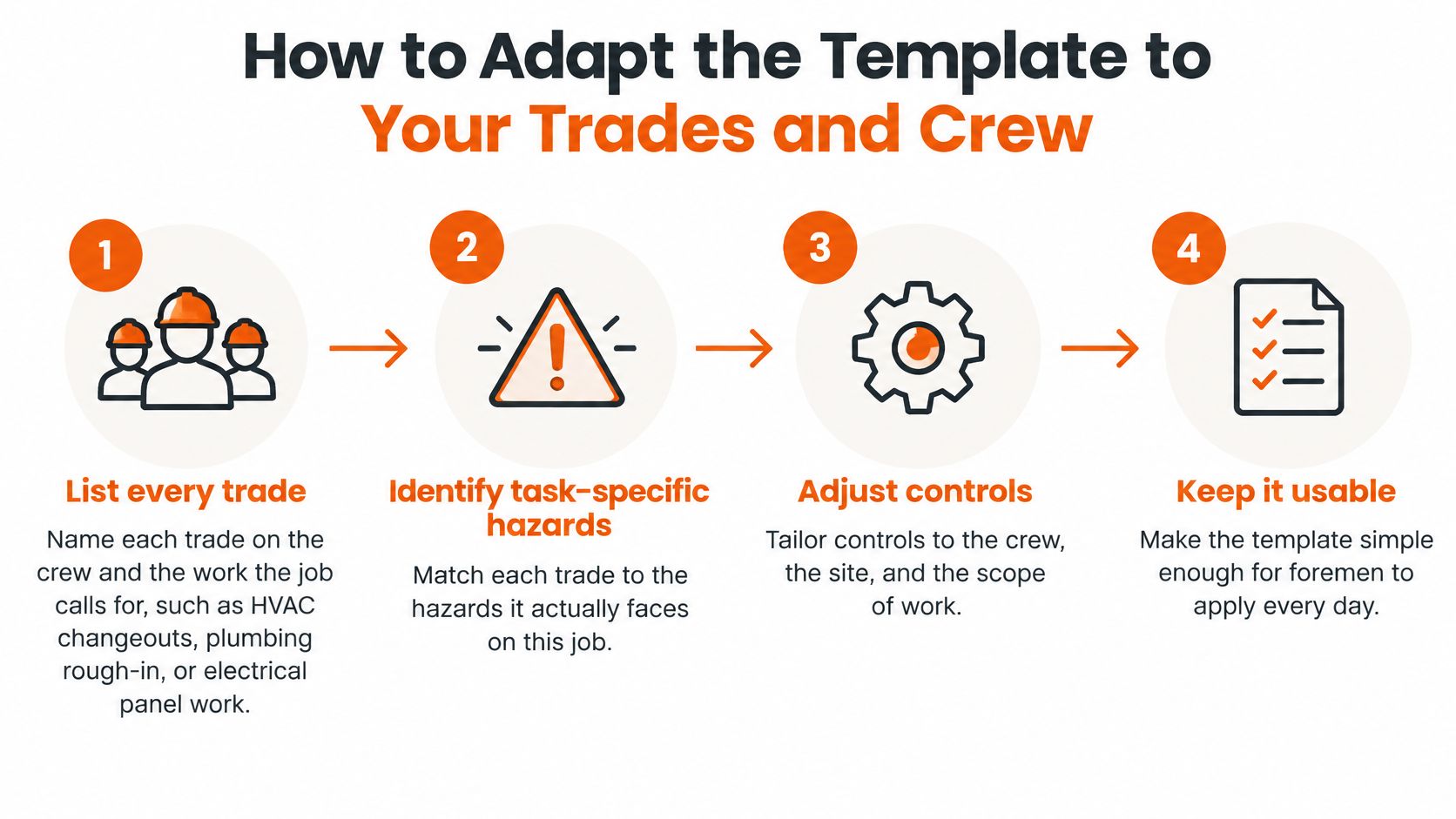
List every trade on the crew and the work the job calls for. HVAC changeouts, plumbing rough-in, electrical panel work and fire-stop penetrations pull in different hazards, tools and training. You can't select tasks from a library until you know which trades are on site.
Select from the actual scope, not the full library. Mark the sections that don't apply and record why. A dismissed confined space section with a one-line reason reads as judgement; an included one with no entry reads as boilerplate.
Check the state rules. Washington requires every construction employer to develop a formal accident prevention program, adapted to its operations and hazards, and to outline it in writing under WAC 296-155-110. California's Injury and Illness Prevention Program under 8 CCR 3203 adds its own requirements on lead, heat illness, trench permits and injury reporting. Federal text alone won't satisfy either.
Name the control type and the reason it appears. Each record should state the initiating condition, the exposed population, the control type, the responsible party, the verification method and the residual risk. Design-stage thinking pays off here: CPWR's Prevention through Design resources treat elimination during planning, through choices about structures, work methods, equipment and materials, as preferable to downstream PPE alone (CPWR). Its electrical task-analysis documents separate conduit installation, wire pulling, termination, grounding, busway and cable-tray work, and electrical demolition, each with its own hazards and health exposures.
Assign one owner to each control. Shared ownership means nobody answers when a guardrail is missing. A named person can be asked, and can be trained.
Add the site details. The emergency plan kept at the job, the general contractor's safety requirements, the assembly point, and the languages your crew speaks. A company's program is built from its trades, the work its crews do and its state, so no two companies should end up with identical sections.
Walk the crew through the draft before it's final. Their edits are the cheapest quality control you'll get, and the record of those edits is evidence the document was communicated.
Worked example, HVAC changeout versus underground plumbing
A four-person HVAC crew replacing rooftop units needs task records for roof access, curb and unit handling, rigging or crane picks, electrical disconnect and lockout, refrigerant handling and hot work permits. Fall controls dominate.
A plumbing crew doing underground rough-in needs trench and excavation, shoring or sloping, confined space, soil and water conditions, and heavy equipment interfaces. Excavation controls dominate, and roof work may not appear at all. Same master template, different document.
Writing Hazard Records That Hold Up on Site
A hazard record is one page that survives a tailgate meeting and a general contractor's review.
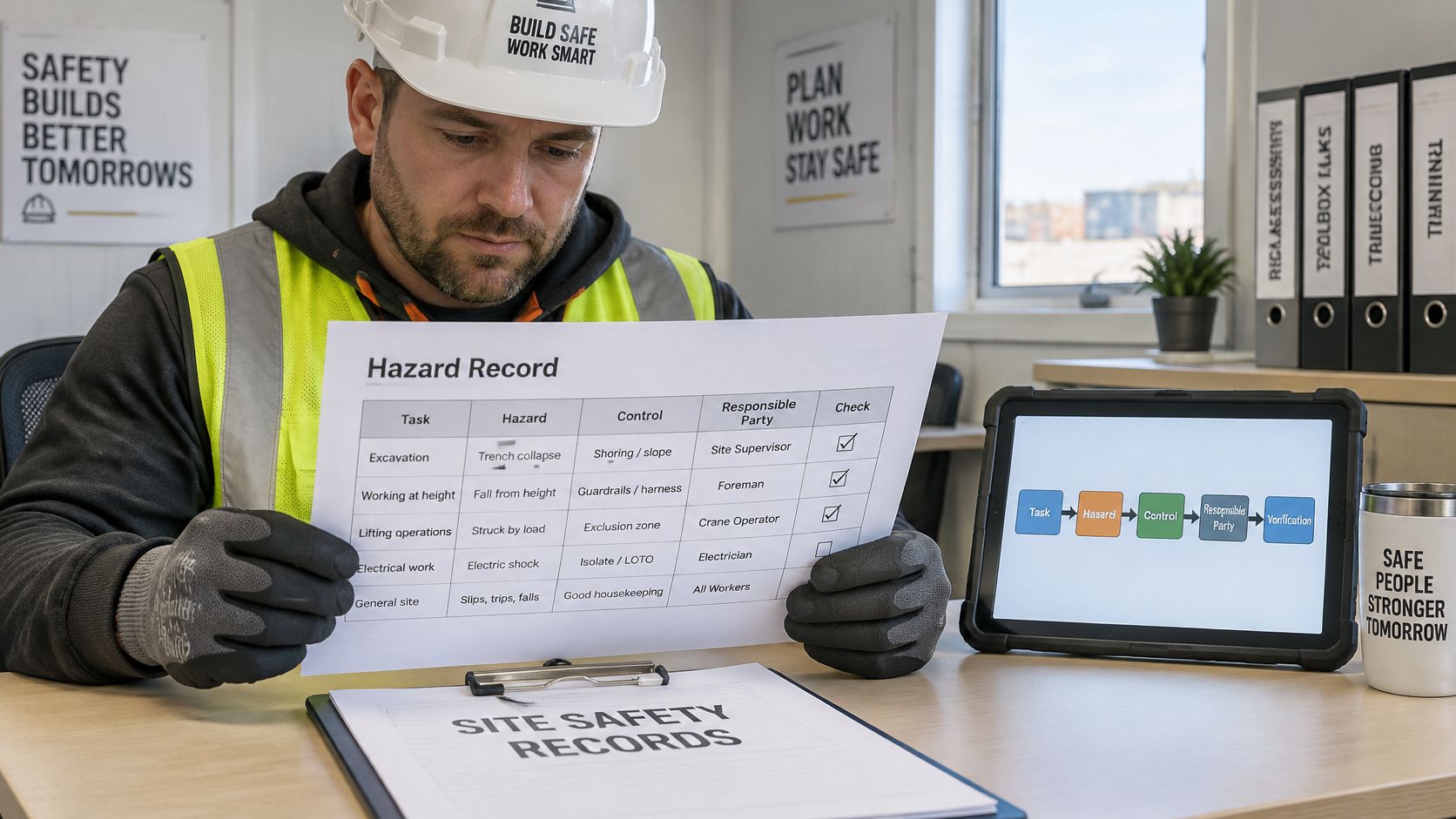
Treat each task as a changing work system, not a checklist. CPWR and NIOSH research on pre-task planning defines it as documenting work steps, associated safety and health hazards, and controls before work begins. The field study behind that work interviewed 28 construction safety professionals and 104 workers, and observed seven onsite planning sessions.
The chain a hazard record has to complete
Every selected task should trace from work sequence to hazard to control to responsible party to verification to residual risk, then on to the training requirement and the inspection item that confirms it. Break the chain and the record becomes a paragraph nobody checks.
Take conduit installation. The work involves overhead runs, ladder or lift access, cutting, bending and energized work nearby. The record states the control, for example staging materials and using a lift with a work platform rather than a ladder for the long overhead run, names the foreman as owner, and lists the inspection item as the platform guardrail check before use.
Explain the hierarchy in plain words on the page. Remove or redesign the hazard first, then guard it with engineering controls, then manage it with procedures and rotation, then use PPE as the last layer. A record that jumps straight to gloves and glasses tells a reviewer the hazard was never analyzed.
Why a control that looks right fails on site
Generic templates fail in recognizable ways. The CPWR study found inconsistent terminology, a compliance-only emphasis, limited worker input, insufficient task specificity, and poor alignment between documented controls and what the task requires.
Worker input is a control-quality issue. Say the plan requires the lift's basket to stay a set distance from an overhead line. The crew knows the boom can't reach that position without parking in a drainage swale. The control is unusable, and without a worker in the room it gets written anyway.
The video below walks through how a pre-task plan gets built and used in the field.
Close each record with a short pre-start confirmation, a signature and time, and an update note whenever conditions change. Effective pre-task planning gets updated regularly and covers both the worker's own task and the surrounding project, including other trades working the same area.
A hazard record with no update line is a historical document the moment the first crew meeting ends.
Keeping the Template Current After Mobilization
Complete is not the same as current. A plan can be thorough, well formatted and fully signed, and still be wrong by the second week, because the trades on site changed, the sequence moved, or the weather turned.
OSHA expects frequent and regular jobsite, material and equipment inspections by designated competent persons, along with periodic evaluation of whether the program is working, and its construction compliance guidance recommends tracking injury, illness and hazard-report trends. That's a change-management instruction wearing a compliance hat.
| Trigger | What to update | Who approves | Evidence to keep |
|---|---|---|---|
| New trade joins the site | Task list, hazards, interface controls | Project supervisor | Revised plan and crew sign-off |
| Sequence or method changes | Work steps and controls for affected tasks | Foreman with safety lead | Updated pre-task plan |
| Incident or near miss | Hazard records, training, inspection items | Company safety lead | Incident report and corrective action |
| Weather or heat shift | Heat controls, work-rest rules, escalation path | Supervisor with authority to pause work | Daily conditions and actions log |
| General contractor comment | Affected sections and controls | Company principal | Versioned reissue with date |
| Regulatory change | Cited standards and program text | Company safety lead | Revision log entry |
The questions that separate a field process from a filed PDF are simple. Who approves a revision? Where is the prior version kept? Which inspection item proves the new control was installed?
Heat is the test case for change control
Heat exposes the weakness faster than anything else, because it changes hour by hour. Contractor survey reporting on heat practices found that more than 80% of contractors used core heat controls such as water, rest, shade, training, emergency response and environmental monitoring, while newer tools including forecasts, mobile heat-safety apps and PPE-based risk assessment remained unevenly adopted. The same reporting found that 72% of contractors in states with heat standards said those standards improved heat-illness protection, including on projects outside the regulated state.
What that means for a template is concrete. Include acclimatization for new and returning workers, work-rest decision rules, a named supervisor with authority to pause work, communication in the crew's languages, hydration and shade logistics, escalation to emergency care, and a daily log of conditions and the actions taken. PPE alone is not a heat strategy, and a static heat paragraph is worse than none because it implies someone is watching.
Keep regulatory duties distinct from employer practices. OSHA's recommended program practices aren't themselves mandatory, while individual standards impose specific duties such as fall protection, hazard communication and fire prevention. Label which is which so a reviewer can tell why each line exists.
Confirm the Template Fits Before You Mobilize
Run this check in one sitting before the first crew shows up.
- Every selected task has a record with hazards, controls and a named owner.
- State rules and cited standards appear where they change the control, not in a lump at the back.
- The crew has reviewed the draft and their input is written down, not just discussed.
- The site emergency plan is at the job, with the nearest medical facility and assembly point, and it gets reviewed with the crew at the start of work.
- The revision log shows version, date and approver, and workers have signed the version in force.
If assembling those records by hand is what keeps pushing mobilization back, a questionnaire-driven builder such as SiteSafetyPack produces a site-specific draft from the selected tasks, with regulatory citations and company-practice controls labeled separately, downloadable in Word and PDF; free job hazard analysis, pre-task plan, hot work permit and fall protection templates cover the gap in the meantime. The draft still needs employer review, and it supports rather than replaces legal or safety-compliance advice.
The template protects nobody on its own. It protects the crew on the day a foreman reads the right version, matches it to the work in front of them, and updates it when the work changes.
A construction safety program template is only as good as the field process wrapped around it, which is why SiteSafetyPack builds plans from your selected tasks, your trades and your state rather than handing you a generic binder. Answer the project questions, review the draft with citations and company practices clearly labeled, then download it in Word and PDF and keep it current through reissues as conditions change. Visit SiteSafetyPack to see how the plan comes together before your next mobilization.