Safety and Health Program Sample: What to Include
Learn what a safety and health program sample includes, how to tailor it to your trades, and how to assign duties and training that hold up on site.
The U.S. Bureau of Labor Statistics reported 1,034 private-sector construction deaths in 2024, including 389 caused by falls, slips and trips (BLS). Rules on paper don't stop a fall. A guardrail someone installs and someone else checks does.
That gap between the document and the shift is what this guide is about. It walks through a safety and health program sample the way a working contractor uses one, element by element, with a test attached to each: who acts, when, and what record proves the action happened.
It's written for HVAC, plumbing and electrical subcontractors running roughly 5 to 50 field employees, the shops where the owner still runs a crew and the safety manager is whoever has the least to do that morning.
What a Sample Program Is and Is Not
The International Labour Organization reports that at least 60,000 construction workers die in work-related incidents every year, roughly one fatal construction accident every 10 minutes. Construction accounts for about one in six fatal occupational accidents worldwide, and the leading mechanisms are falls from height, crushing, struck-by injuries from falling objects and electrocution. Historical ILO comparisons put construction workers in industrialized countries at about three to four times the risk of dying in a workplace accident compared with workers in other industries.
A sample safety and health program is a model written program. It contains the policies, responsibilities, hazard analysis, training, inspections, emergency arrangements, records and sign-off fields that a general contractor or a regulator expects to see, and a company adapts it into its own document with its own name, trades and sites in it. That's the job description. It is not compliance on its own, and it is not risk reduction.
Two failures show up again and again. The first is the binder: a program printed, signed at orientation, filed, and never opened again, which changes nothing about how a crew works. The second is the copy: a template pulled from another firm's website that describes hazards your crews never meet and skips the ones they meet every day.
The test for any line in a sample: who acts, when do they act, and what record proves it happened. If you can't answer all three, the line is decoration.
Say a two-person HVAC crew downloads a generic program before a rooftop unit swap. The document spends pages on trenching and scaffolding, then says nothing about landing a curb adapter on a roof, brazing refrigerant lines, or locking out the unit disconnect before the fan is opened. The crew signs the acknowledgment because signing takes a minute and the document feels irrelevant.
A useful sample does something narrower and harder. It ties each work activity to its hazards, its controls, its training, its emergency steps, its inspections and a worker signature. Everything below builds that link.
The Seven Core Elements Every Sample Covers
OSHA's construction safety guidance organizes a program around seven elements: management leadership, worker participation, worksite hazard analysis, hazard prevention and control, education and training, program evaluation, and communication and coordination for contractors; the same guidance notes that one in every five workplace fatalities is a construction worker, says its recommended practices were updated in 2016, about 30 years after the earlier program guidelines, and frames the approach for varied small and medium-sized businesses. For a subcontractor, that means you do not need every entry a 500-person general contractor keeps. You need the entries that match your trades, your crew size and your sites, and each one has to be fillable by a person with a name.
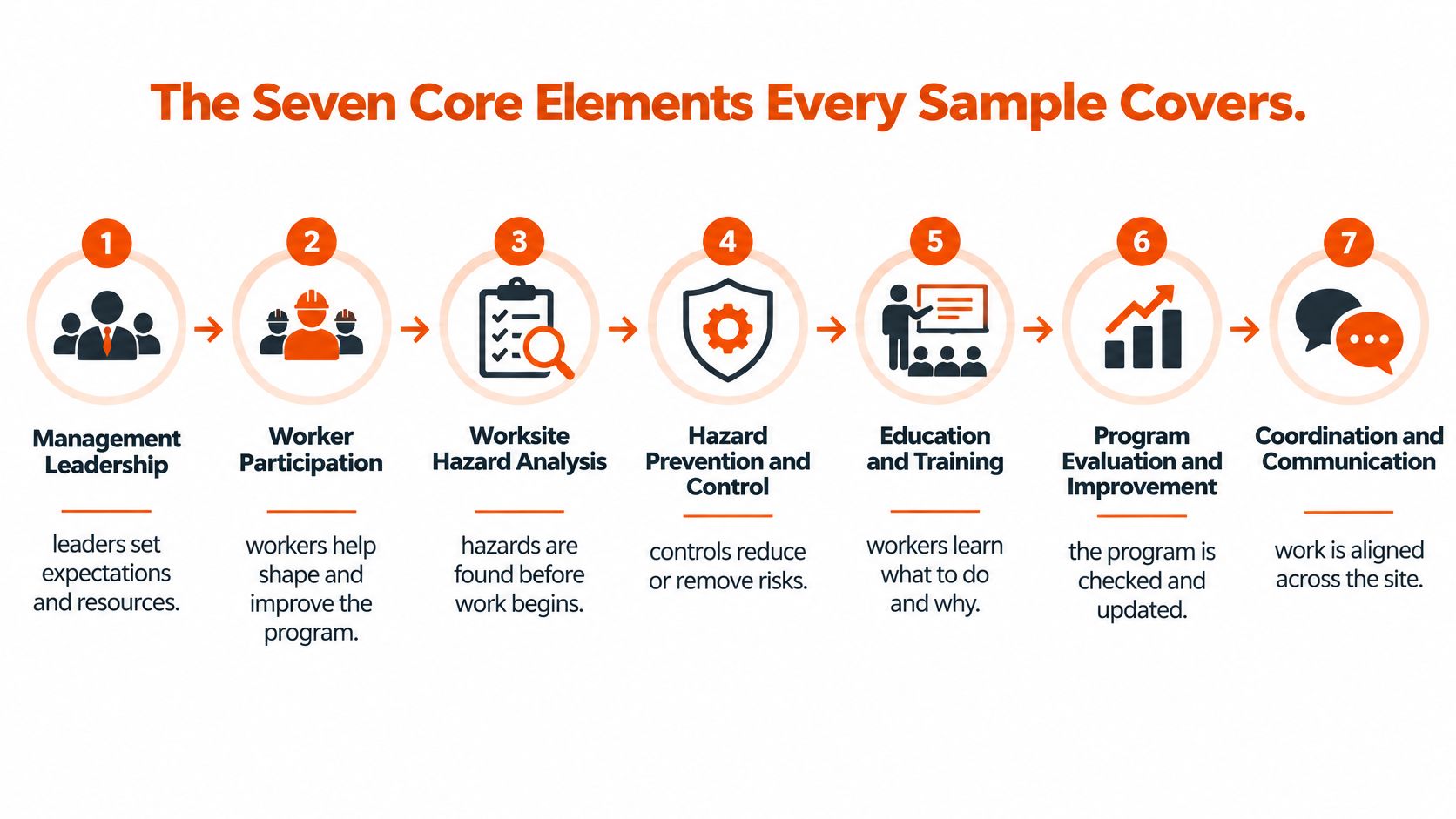
Use the table as a checklist against whatever sample you're holding. A missing entry in the right-hand column is a gap, not a formality, and each row should answer three questions: who acts, what triggers the action, and what record proves it happened.
| Element | What it covers | Entry the sample must contain |
|---|---|---|
| Management leadership | Commitment and resources from the owner | Signed policy statement naming the program owner and review date |
| Worker participation | Crew input on hazards and controls | Stop-work route, suggestion path and toolbox talk sign-in |
| Worksite hazard analysis | Hazards from routine, nonroutine and emergency work | Task-by-task job hazard analysis with reassessment triggers |
| Hazard prevention and control | Controls ranked by effectiveness | Control hierarchy plus a field check that the control is installed |
| Education and training | Competence for each task and hazard | Training roster, toolbox talk record and task sign-off |
| Program evaluation | Checking whether the program works | Inspection log, incident report and revision log |
| Communication and coordination | Shared rules with host employers and other trades | Coordination notes and site emergency information |
How the elements loop instead of stack
Read top to bottom, the table looks like a checklist. Run it on a job and it behaves like a loop. The hazard analysis decides which controls belong in the plan, the controls decide what training has to cover, and the training roster tells the foreman who is cleared for the task tomorrow morning.
Then the loop closes. Inspections and incident reviews feed program evaluation, and evaluation sends changes back into the hazard analysis. OSHA's job-hazard-analysis guidance treats reassessment as part of the work whenever tasks, site conditions or controls change. A sample with no reassessment trigger has no way to learn anything.
A usable line names the actor, the trigger and the proof. "The crew will be trained" fails all three. "Before the first cut, the foreman reviews the saw JHA with the crew, each worker signs it, and the signed form stays in the day's paperwork" passes because it assigns the action, sets the moment and leaves a record.
Tailoring the Program to Your Trades
Start with the work, not the trade name. Write down what your crew will do on this job over the next month: set three rooftop units, braze refrigerant lines, core a wall for a condensate drain, pull feeders to two panels, install a grease interceptor in a pit. That list is the spine of the program, and every row of the table below is a lookup you do against it.
| Trade or area | Typical hazards | Common controls | Documents to attach |
|---|---|---|---|
| HVAC | Rooftop falls, refrigerant and brazing hot work, lifting heavy units | Fall protection, lift plan, lockout at unit disconnects, fire watch | Fall protection plan, hot work permit, lift plan |
| Plumbing | Trench collapse, soldering hot work, confined pits, solvent vapors | Protective systems, competent person inspection, ventilation, entry controls | Excavation plan, hot work permit, confined space permit |
| Electrical | Energized work, arc flash, shock, work at height | Lockout/tagout, voltage testing, arc-rated PPE, de-energizing before work | Energized work permit, lockout procedure, PPE hazard assessment |
| Shared work area | Overlapping hazards, open penetrations, shared lifts and traffic | Coordinated pre-task plan, shared hold points, barricades | Pre-task plan, job hazard analysis, coordination notes |
A trench entry, worked through
A plumbing crew installing a drain in a trench has a task that belongs to more than one trade section. The moment anyone steps below grade, the job becomes a trench-entry task, which means a competent person inspects it, a protective system matches the soil and depth, and someone repeats that check before the first entry of each shift. The hot work permit for soldering nearby is a separate attachment, and it needs its own fire watch.
That's what tailoring looks like in practice. The program sentence reads: drain installation in a trench, checked by the competent person each morning before entry, with the excavation plan and the hot work permit attached to the task.
Delete what your crews won't touch
The shared-area row earns its place because two trades working under one hold point create hazards neither plan names alone. Your electrical rough-in may sit directly above a plumber's open trench, and the scissor lift may be the only one on site for six crews.
Cutting rule: if your crew won't do it this year, delete the row. A twelve-page program that matches your work gets read; a forty-page one padded with irrelevant hazards gets signed and shelved.
Before you finalize, trace every hazard to a control and, where a regulation applies, to its citation. Then check the state. Washington requires every construction employer to develop a formal accident prevention program suited to its operations and hazards, and to outline it in writing under WAC 296-155-110. California's Injury and Illness Prevention Program under 8 CCR 3203 sets its own eight elements. Federal rules won't cover a state with a stricter standard, so confirm local requirements before the program goes to a general contractor.
Assigning Responsibilities Across Your Crew and the General Contractor
Vague responsibility statements are the most common reason a program collapses in week two. A line like "management will ensure a safe workplace" names nobody, sets no deadline and produces no evidence. Every duty in the document needs three parts: a role, the authority that role carries, and the record that proves the duty was performed.
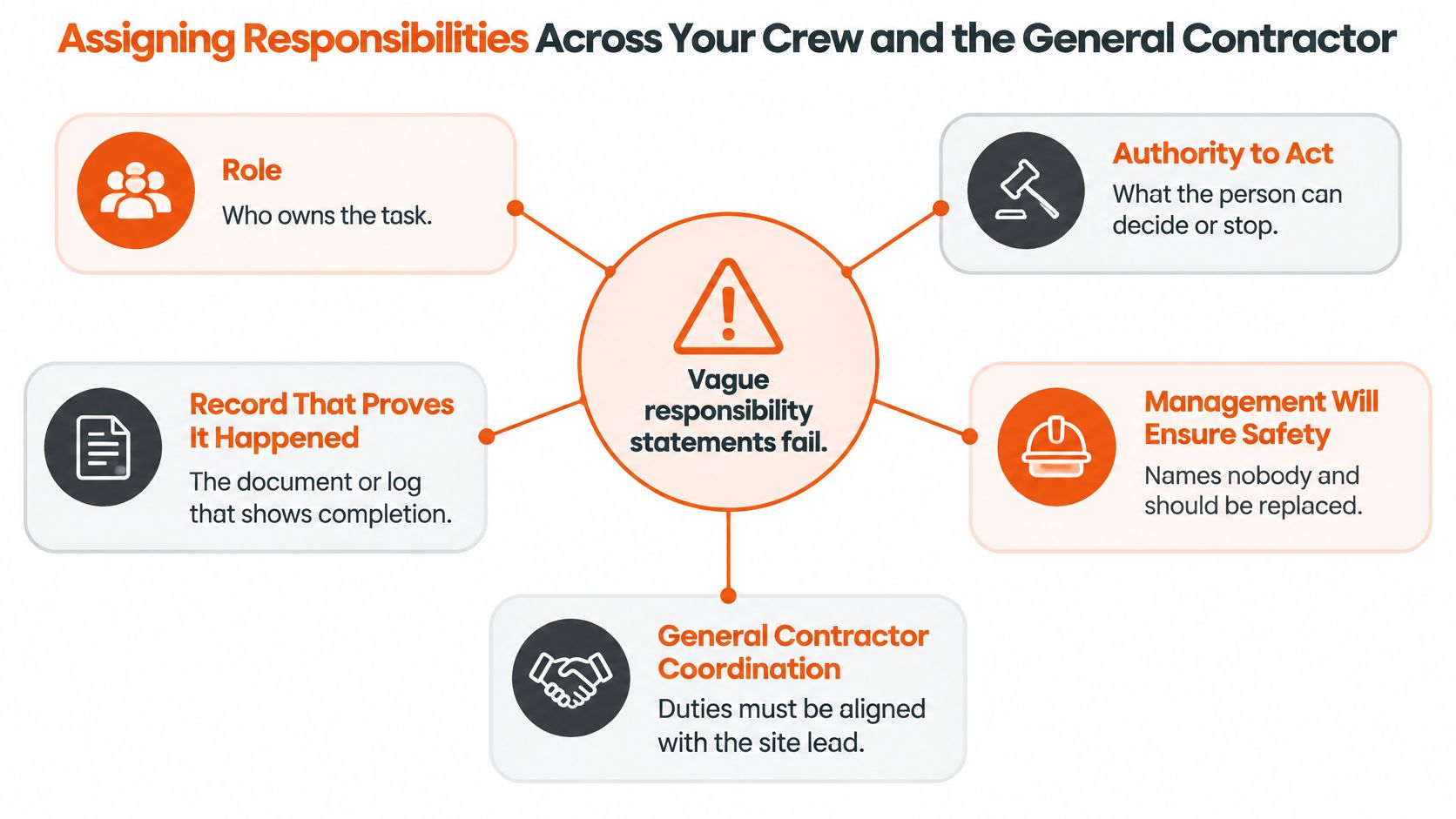
| Role | Main responsibility | Evidence to keep |
|---|---|---|
| Owner or executive | Approves the program and funds controls | Signed approval and revision log |
| Supervisor | Runs pre-task plans and enforces controls | Signed pre-task plan and corrective-action notes |
| Competent person | Identifies hazards and holds stop-work authority | Inspection log and hazard reassessment records |
| Workers | Follow controls and report hazards or near misses | Employee acknowledgment forms and reporting log |
| General contractor | Sets site-wide rules and coordinates trades | Coordination meeting notes and site emergency information |
In a small firm the owner often runs a crew, so the sample should say which hat is worn when. Approving a lift plan is an owner decision. Signing that day's pre-task plan is a supervisor one. Writing both into the same person without naming the hat is how controls get approved by somebody who never saw the roof.
Escalating a hazard that nobody owns
On a multi-employer site your crew works under the general contractor's rules, and the program has to say what happens when a hazard crosses that line. A short path beats a long policy:
- Stop the task. The competent person or the supervisor halts the work and clears the area.
- Report it. Whoever stopped it tells the supervisor, and the supervisor records the hazard and the time.
- Notify the general contractor's site safety contact. Get a name and a decision, not a promise to look into it.
- Record the restart. Note the fix, the date, and who approved resuming work.
OSHA's guidance requires control responsibilities to go to people with the authority to implement them, and it requires subcontractors and temporary workers to be included. The size of the exposure explains why this matters. Specialty trade contractors accounted for approximately 61% of construction fatalities from 2011 to 2022, and businesses with 1 to 10 employees accounted for 57% of fatal injuries and 70% of deadly falls, according to OSHA's safety and health program guidance. Small firms are not a side case. They're the ones who most need a name beside every duty.
Training and Records That Show Workers Understand
A training section needs five parts to be usable: the delivery method, the audience, the learning objective, how workers take part, and the evidence that they understood. A topic and a signature line cover none of them.
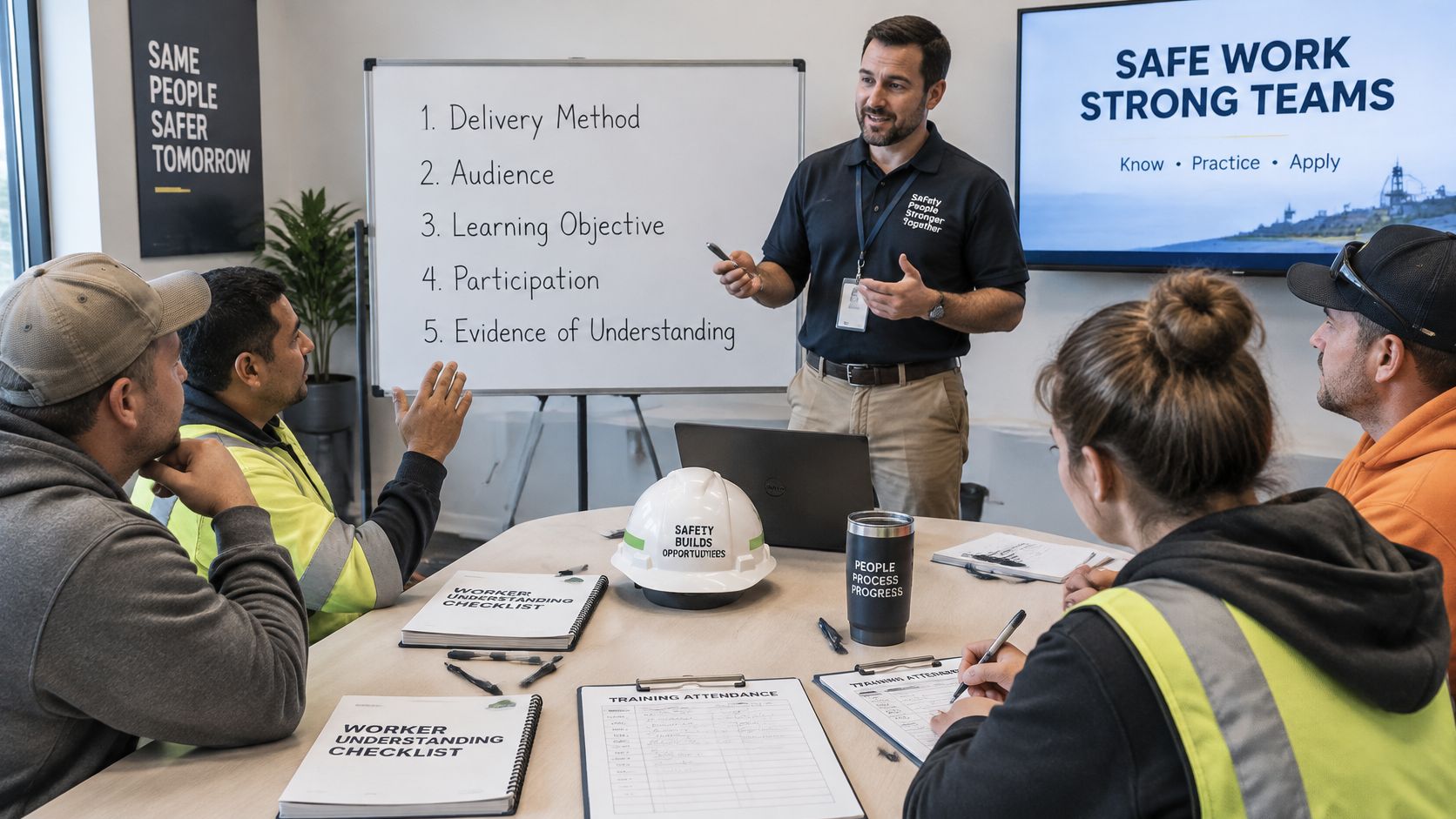
Take a five-minute pre-shift talk on ladder use. The supervisor names the task, setting a 24-foot extension ladder against a two-story wall to reach a rooftop disconnect. Then he names the hazard: the ladder slipping at the base on a graded surface. He asks the crew what could go wrong if the feet aren't set and the ladder isn't tied off. One worker demonstrates three-point contact and the tie-off. Any gap the crew raises gets an owner and a date.
The record for that talk holds the task, the hazard, the control, the required PPE, the questions workers raised, the actions they took, and the follow-up owner. The sign-in sheet sits underneath it, not in place of it.
The CDC and NIOSH evaluation of construction toolbox talks found that versions containing narratives and discussion questions produced significantly greater knowledge gain and training impact than standard versions, with the benefit particularly notable among less-experienced workers. The same body of work supports short, task-specific briefings tied directly to that day's hazard analysis rather than a general weekly safety meeting.
Check comprehension rather than attendance. Ask two workers to explain the control, watch one set the ladder, look at the tie-off during the shift, and note what you find. Attendance proves somebody sat down. A field observation proves the control is being used.
Covering Heat, Fatigue and Mental Health Risks
Most samples handle falls, electrical exposure, struck-by hazards and PPE reasonably well, then go quiet on heat, fatigue, hazardous substances, stress, bullying and substance use. The quiet is the problem. These risks respond to the same machinery as the physical ones: a trigger that starts the action, an owner who acts, a control that reduces the exposure and a record that proves it happened.
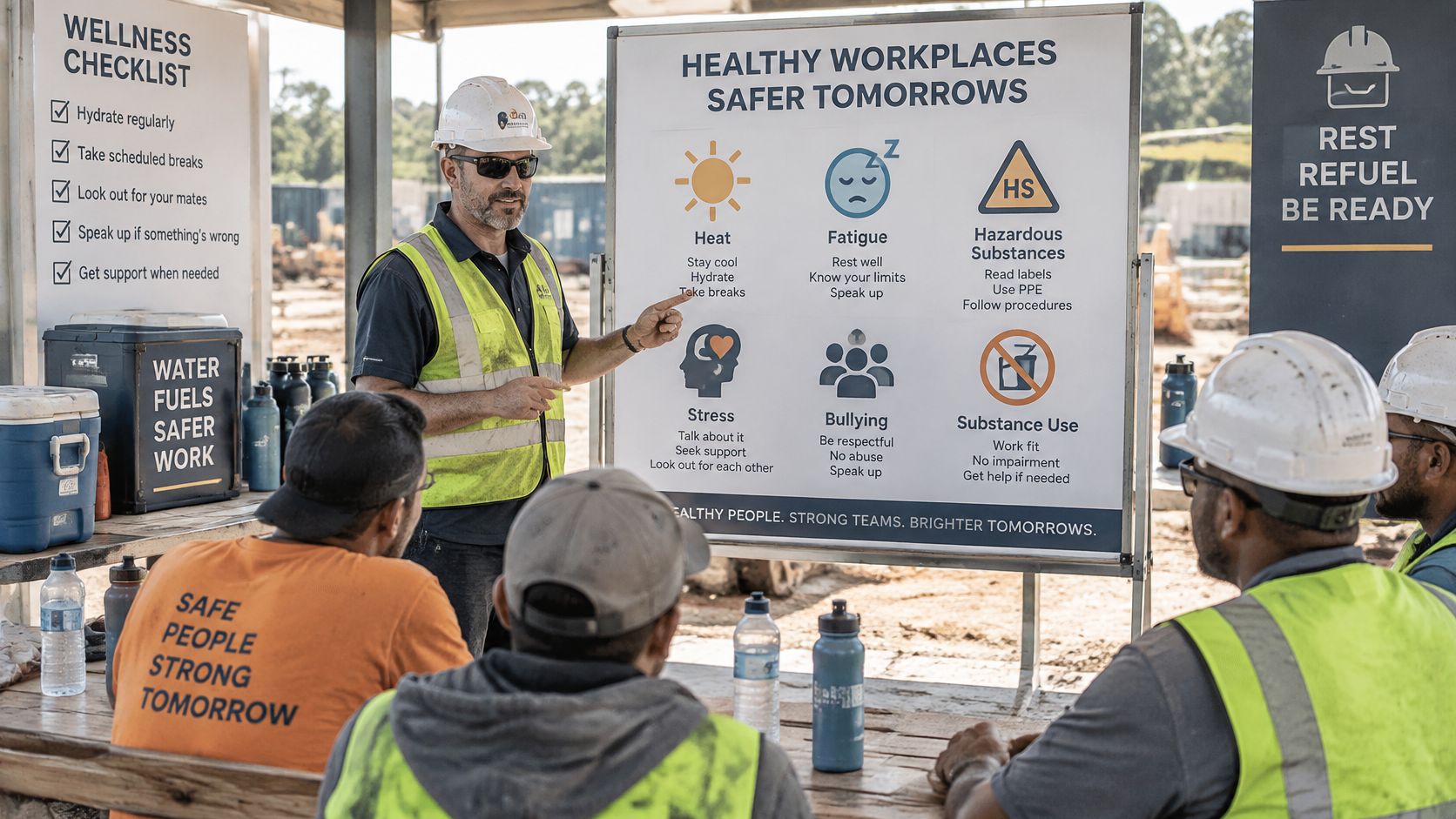
Ireland's Construction Safety Partnership Action Plan 2025 to 2027 names stress and bullying among its priorities and calls for targeted tools for small contractors, new entrants and self-employed workers. The same plan reports a gap between what companies say they offer and what they apply: 57% of contractors reported offering mental-health or substance-use training, while engineering heat controls, acclimatization, cooling PPE and physiological monitoring were used by 50% or fewer of respondents.
| Risk | Trigger | Control | Record |
|---|---|---|---|
| Heat | Forecast heat or heavy work in direct sun | Water, shade breaks, acclimatization schedule, cooling PPE | Daily heat log and acclimatization checklist |
| Fatigue | Long shifts, overtime or night work | Scheduled breaks, shift limits, rotation of heavy tasks | Shift records and break logs |
| Hazardous substances | New product or chemical on site | Safety data sheet review, respirator fit test, ventilation | Chemical inventory and fit test record |
| Stress and bullying | Reports from workers or supervisors, schedule pressure | Reporting route, supervisor check-ins, referral options | Confidential conversation log and corrective-action notes |
Read one row the way a crew would live it. For heat, the supervisor checks the forecast before the shift starts, that is the when. He orders water, shade and a break schedule once the trigger is met, that is the control. He signs the daily heat log and initials the acclimatization checklist for any worker in their first two weeks, that is the record. If a row in your program cannot name who acts and when, it is a wish, not a control.
Add a return-to-work step for anything on that table. Name the person who decides, which is usually the supervisor with the owner, and the evidence they need before the worker resumes full duty: a written clearance where one is required, a cooler task for the rest of the shift, a hydration plan, and a short follow-up conversation logged in the record.
That gap between policy and practice is also a warning about forms. A completed digital checklist proves someone tapped a screen. It says nothing about whether a worker got shade, a rotated task or a fit test that day.
Pair every emerging-risk policy with a supervisor conversation, a worker comment and a field check, then log the check. The conversation is the control; the record is just the proof it happened.
Confirm Your Program Before Mobilizing
The last pass takes an hour and saves the first week on site. Work through it in order, and don't move to the next step until the current one has a name attached.
- Cut the sample to your scope. Compare it against the trade table for this job and delete rows that don't match the work. Shorter and accurate beats complete and ignored.
- Run the seven-element gap check. For each element, confirm the entry names a person, a date and a record. Flag anything that only restates a rule.
- Read the responsibility matrix out loud. Every duty needs a role, the authority to act, and the evidence kept. If a duty has no owner, assign one or delete it.
- Test the training section. It should list delivery method, audience, objective, worker interaction and evidence of understanding for the tasks on this job.
- Post the emergency plan. Confirm it's kept at the job and reviewed with the crew at the start of work, with the site address, muster point and nearest medical facility filled in.
- Decide how you'll build and maintain it. In-house drafting is free and slow. A document-assembly service trades that time for a fee.
One distinction trips people up. A site-specific plan lists the written programs a job calls for, with citations, but it doesn't contain those programs. The company safety program is a separate document, and it's included with the annual Pro subscription rather than inside each plan. You can upload the company safety program as your written program to prequalification platforms such as ISNetworld, Avetta or Highwire, though nobody can promise a prequalification service will accept it. Ours downloads as an editable Word file and a PDF, so a general contractor's forms can be dropped into the same document.
Document preparation is not legal or safety-compliance advice. Have a qualified safety professional read the finished program against your state and federal rules before it goes out with a bid.
A company safety program that names your trades, your crews and your state is the difference between a document a general contractor accepts and one you rebuild every quarter. SiteSafetyPack assembles that program from your trades and the work your crews do, on OSHA's seven core elements and with the forms and written programs your work calls for, delivered as editable Word and PDF files. Start at SiteSafetyPack and preview the program before you download it.