Construction Project Safety Plan: What to Include and Why
A construction project safety plan explained: the sections, hazard controls and review steps subcontractors need before mobilizing on site.
At least 108,000 construction workers are killed on site every year, and construction accounts for roughly 30% of all fatal occupational injuries worldwide, according to the International Labour Organization. A sector that employs a modest share of the global workforce carries a wildly disproportionate share of its deaths.
Paperwork doesn't fix that. A foreman standing on a roof at seven in the morning, holding a document that tells him what can hurt his crew today and what has to be true before they start, does. That's the gap between a construction project safety plan that gets filed and one that gets used, and it's the gap this guide is built around.
Why Every Construction Job Needs a Written Safety Plan
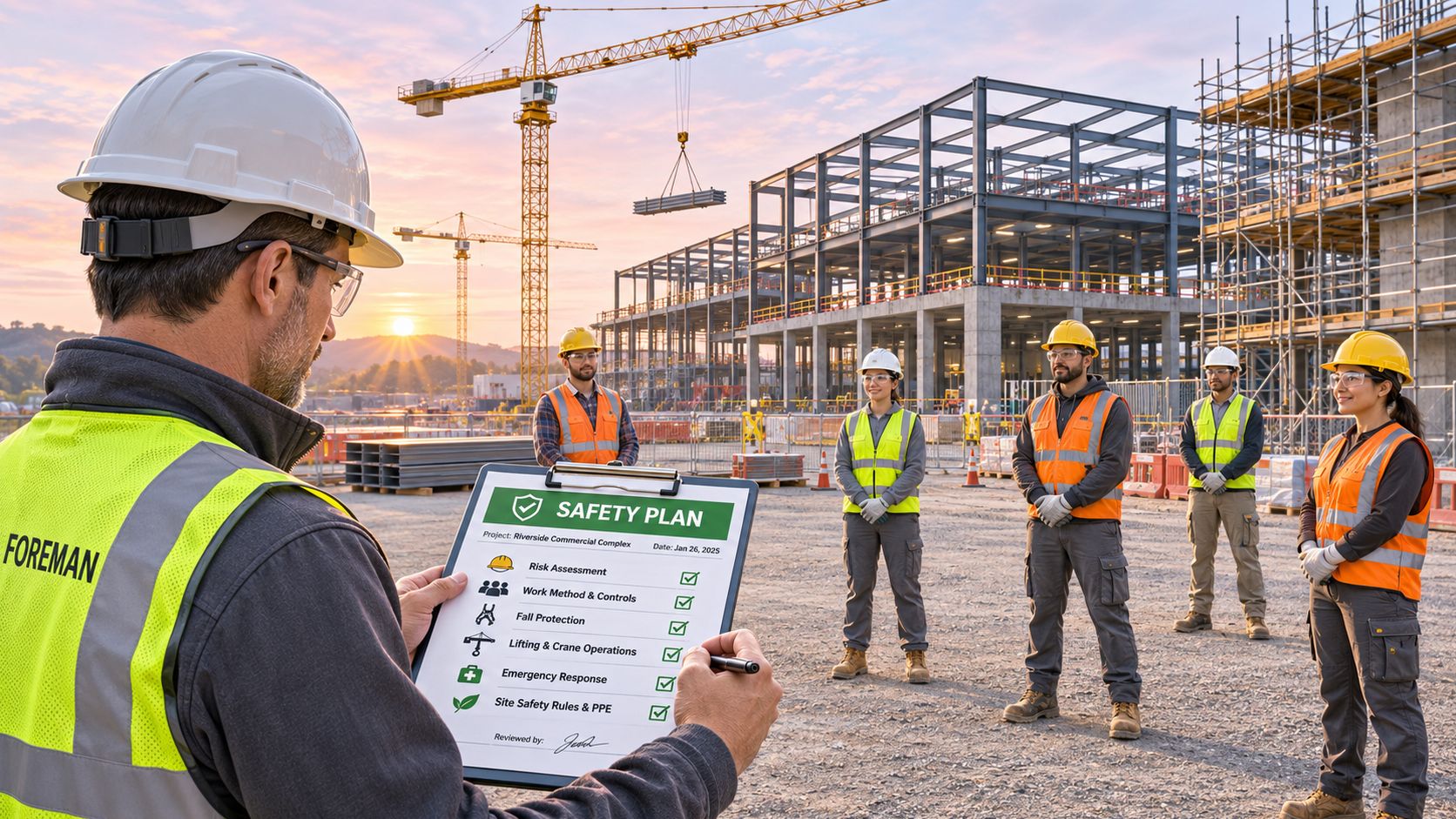
The case for writing it down doesn't rest on compliance. It rests on the fact that construction risk concentrates in a handful of activities that repeat on every job, and the controls that answer them have to be attached to the specific work rather than to the company as a whole.
The hazards that kill are unglamorous and well known: falls from height, crush injuries, struck-by incidents and electrocution. What changes from job to job is everything around them. A crane pick over an occupied sidewalk is not the same pick over an empty lot. Brazing near combustible roof insulation is not the same brazing on a bare deck. A disconnect on a live panel in an occupied building is a different animal from the same disconnect after the utility pulls the meter.
A written plan converts those broad categories into project controls. It assigns a person to each control, defines what the crew does when something goes wrong, and puts the precautions in front of workers before the first task begins. For a subcontractor it does something else too: documenting the selected tasks, site conditions, training needs, protective equipment and inspection arrangements gives the general contractor and the other trades something concrete to coordinate against.
A binder and a plan are different objects. The binder lives in a trailer and gets opened during an inspection. The plan lives on a clipboard at the tailgate, gets read out loud at 6:45, and gets amended when the crane shows up smaller than the one the lift was designed around.
Here's the order this guide follows: what the document contains, how site conditions and work activities drive it, how to rank hazards and choose controls that hold, who owns each part, a full rooftop example, and how to review before mobilization.
What a Construction Project Safety Plan Contains
A flight checklist earns its place one item at a time, because each line exists after somebody skipped it and something went wrong. A construction project safety plan works the same way. It isn't one form. It's a set of connected parts, each answering a single question.
The regulatory frame around those parts is recent in historical terms. The Occupational Safety and Health Act, signed by President Richard Nixon on December 29, 1970, created OSHA and moved safety from something handled inside individual companies to a national system of enforceable standards, inspections and employer duties. The results are documented in OSHA's introduction to the agency: estimated U.S. workplace deaths fell from about 14,000 in 1970 to about 5,190 in 2021, a reduction of nearly 63%, while the recorded injury and illness rate dropped from 10.9 per 100 workers in 1972 to 3.6 per 100 in 2016. Construction kept its share of the danger, with 991 construction fatalities reported in 2016, about 2.7 deaths a day. Standards and documented systems moved those numbers. They didn't finish the job.
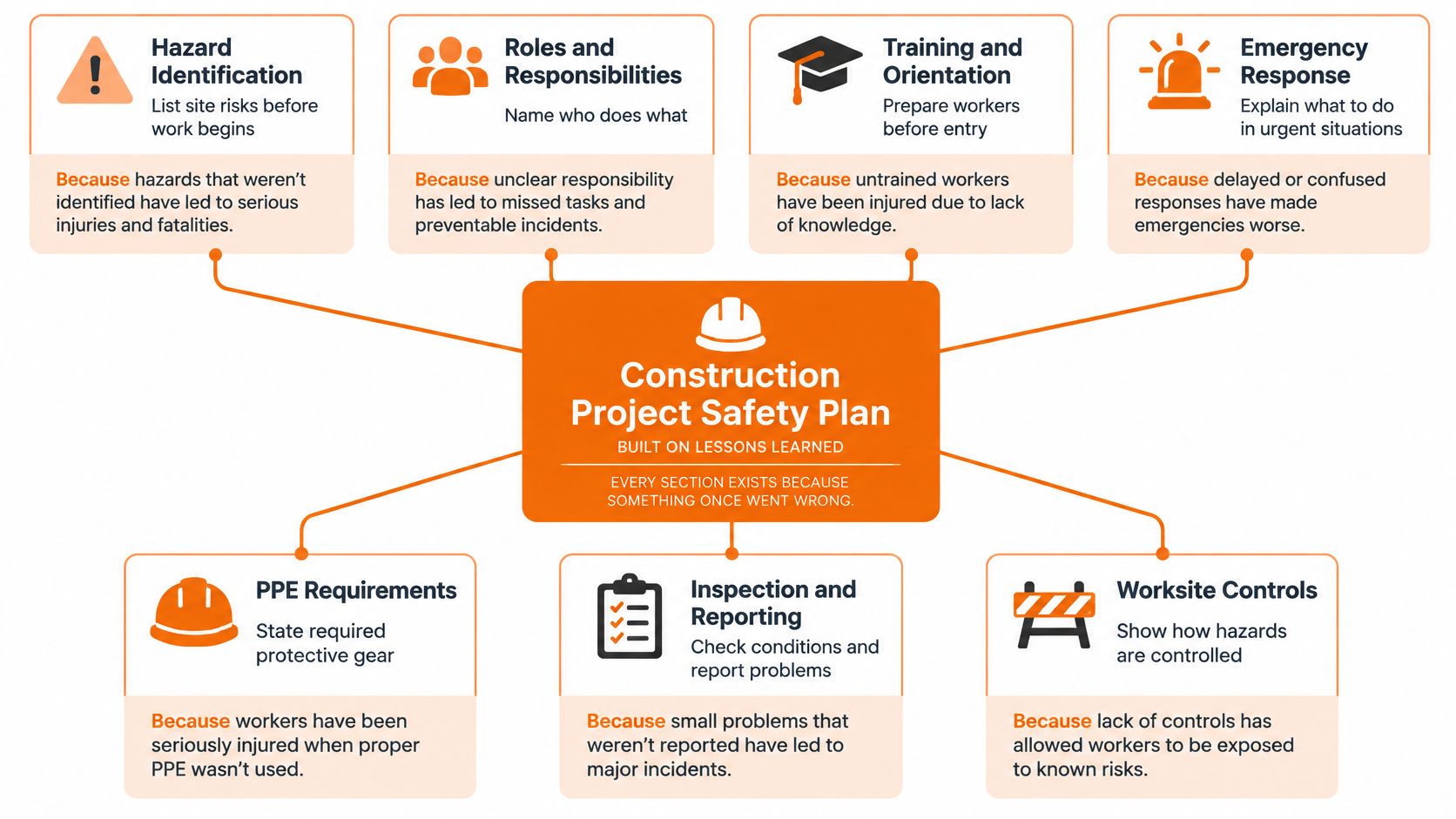
The parts, and the question each one answers
| Component | Question it answers | What to record |
|---|---|---|
| Project information | Where and who is this job? | Site address, general contractor contact, start date, crew size, nearest hospital |
| Site conditions | What in the environment changes the risk? | Access, height, weather, energized systems, ceiling spaces, excavations |
| Work activities | What will the crew actually do? | Selected tasks in sequence, with the trades and areas each task touches |
| Hazard analysis | What can go wrong in each task? | Hazards listed per task with severity, likelihood and exposed workers |
| Controls and standards | How is each hazard managed? | Controls ranked by the hierarchy, with the cited OSHA standard |
| Responsibilities | Who makes sure it happens? | Foreman, competent person, site safety representative and their duties |
| Training and PPE | Is the crew ready and equipped? | Training roster, toolbox talk topics, PPE assessment and requirements |
| Emergency action plan | What happens when something goes wrong? | Alarm method, assembly point, first-aid contact, route to hospital |
| Inspections and review | How do we know it still works? | Inspection log, incident and near-miss review, revision log |
| Approval | Who accepts responsibility? | Employer approval and crew acknowledgment signatures |
Naming the standard behind each control
The controls column is where a plan stops being a wish list. Each control should point to the standard that requires it, inside 29 CFR 1926: Subpart M for fall protection, Subpart K for electrical work, Subpart J for welding and cutting, Subpart F for fire protection and prevention, Subpart P for excavations, Subpart E for personal protective equipment.
The plan also lists which written programs the job triggers, such as a hot work permit or a fall protection work plan. The program text itself often lives in a separate company safety program, and the site plan just names what's needed and where it sits.
Run the copy test. Read each section and ask whether it could be pasted into any other job unchanged. If it could, it's too general. "Employees shall wear appropriate PPE" fits every project in the country. "Arc-rated hood and gloves for the 480V disconnect at panel LP-2, lockout applied by the electrical foreman before cover removal" fits one.
Start With Project Conditions and Work Activities
A hazard list is only as good as the job description underneath it. That's why the work comes before the paperwork. Start with conditions: site layout, access routes, building height, weather exposure, temporary power, occupied areas next door, and which other trades will be working at the same time.
Then break the work into steps. The CDC and NIOSH guidance on pre-task planning sets out the method plainly: divide the work into steps, identify the safety and health hazards attached to each step, and select controls before work begins. It also names what makes the difference between a plan that works and one that doesn't, which is direct worker participation, coordination across trades, content a crew can get to, and updates when conditions change.
Six steps for one rooftop unit
Take a rooftop HVAC replacement on an occupied commercial building, and walk it through in the order the crew will.
- Crane lift of the unit. Interfaces with the general contractor's rigging crew and any trade working below. Exposed workers include everyone in the fall zone, not just the pick team.
- Roof curb installation. Cutting and fastening at the roof edge. Interfaces with the roofer, if there is one.
- Refrigerant recovery. Chemical and pressure exposure, plus the machine itself.
- Brazing of gas lines. Open flame near combustible roofing and insulation, and other trades working in the same area.
- Roof penetrations. Holes in the deck that the crew will walk past for the rest of the job.
- Electrical disconnect and reconnect. Energized work unless the sequence is arranged so it isn't.
For each step, the entry records the sequence, the trades it touches, who is exposed, the equipment and materials, and the nonroutine or emergency conditions you can foresee. Notice how hazards move when the sequence moves. Brazing before the roofer lays insulation is a different task from brazing after.
Why the sequence matters more than the trade list
Two jobs with identical task lists can carry completely different risk, depending on who else is on the roof and when. That's the failure mode of assembling a plan from a checklist of tasks: it captures what the crew does and misses what everyone else is doing at the same time.
The foreman's test: can you say what step comes next, what can hurt your crew or someone else's, which control has to exist before you start, who checks it, and what change forces a stop? If the plan can't answer those five, it isn't ready for the tailgate.
Show each task entry to the foreman alongside the actual schedule, not after, and let the crew name the field constraints they've hit on similar jobs. Workers see the blocked ladder access and the missing guardrail cover long before anyone in an office does.
Rank Hazards and Pick Controls That Actually Work
A plan that answers every hazard with gloves, a warning sign and a toolbox talk hasn't controlled much. It has documented that the hazard exists and handed the risk to whoever happens to be nearest.
OSHA's guidance on hazard identification gives the ranking method. Evaluate each hazard by potential severity, likelihood of occurrence and the number of workers who may be exposed. Then go after the highest risks first, with interim controls in place until the permanent fix lands. Three steps, in this order:
- Rate every hazard on all three dimensions, and don't average them. A low-likelihood event that kills several people deserves more attention than a frequent one that causes a bruise.
- Sort by total risk, not by the order the tasks appear in the schedule.
- Assign a control level to each one from the hierarchy, and record what's left over after the control.
Work down the hierarchy, not across it
Controls run from most to least effective: elimination, substitution, engineering controls, administrative controls and personal protective equipment.
| Control level | What it means | Example on a subcontractor job |
|---|---|---|
| Elimination | Remove the hazard entirely | Prefabricate ductwork at ground level to avoid overhead lifting of loose sections |
| Substitution | Replace with a lower-hazard option | Use a lower-toxicity solvent or a pre-insulated fitting instead of a hazardous adhesive |
| Engineering controls | Isolate or guard the hazard | Guardrails at the roof edge, hole covers, ventilation at brazing points |
| Administrative controls | Change how or when work is done | Schedule energized-panel work when the building is unoccupied, with a competent observer |
| PPE | Protect the worker when other levels cannot | Arc-rated clothing for panel work, fall arrest harness where guardrails are not feasible |
PPE is the last line, not the first. Scheduling is a legitimate control, but it's what you use when a risk can't be designed out, not a substitute for a guardrail.
The record that survives a review
Each hazard entry should carry the initiating condition, the credible consequence, the exposed population, the severity and likelihood ratings, the control level selected, the inspection or test that verifies the control, and the residual risk that remains. Six fields plus two judgments. When an inspector or a general contractor's safety director asks why a control was chosen, that row is the answer.
Practical rule: if you can't say who accepts the residual risk, the hazard isn't closed. Naming an acceptor, foreman, competent person or employer, turns a list into a decision.
OSHA also asks for initial and periodic inspections, investigation of incidents and near misses, and trend review to find causes that keep repeating. Feed every near miss back into the task entry it belongs to. A worker who drops a wrench through an open penetration isn't a new file, it's an entry that needs a better hole cover.
Assign Roles, Training and Emergency Response
A control with no name beside it is a suggestion. The moment a crew reaches the condition the plan anticipated, someone has to know that checking it is their job and that they can stop work until it's right.
- The employer approves and owns it. Signing the plan is the act that assigns responsibility for its contents, not a formality at the back.
- The foreman runs the daily review. Every shift, before the first task, the crew hears what's changed and what has to be true before they start.
- The competent person owns specific hazards. Excavations, scaffold, cranes, energized work. The title has to come with authority to stop the task.
- The site safety representative manages interfaces. Multiple trades, one roof, one shared ladder, competing schedules.
- The general contractor contact is named with a phone number the crew actually has.
Training that checks understanding, not signatures
List what the crew needs before day one, then test it the way a foreman would. Ask a worker to explain the control on the task they're about to do. If they can describe what stops them from starting, the training landed. If they can only point at a sign-in sheet, it didn't.
Log toolbox talks by date, topic, presenter and attendees. Keep the topics tied to the tasks on the schedule, not to a rotating list of general subjects. A sample safety and health program is a useful reference for how the written elements fit together with the field records.
An emergency plan the crew has rehearsed
Cover four things in language a new hire can repeat: how the alarm gets raised, where the assembly point is, who calls 911 and from what phone, and who meets emergency services at the gate. Add the route to the nearest hospital in writing, with turns, because nobody finds their way well with a hand injury.
A crew that has never heard the emergency plan will improvise. Improvisation under pressure is how one casualty becomes two.
Review the plan with the crew at the start of the job, before they need it. Close with an acknowledgment step where each worker confirms they've reviewed the hazards for their own tasks, which is a very different act from signing a form at orientation.
A Rooftop Unit Replacement From Start to Sign-Off
Say a mechanical subcontractor wins the rooftop unit swap on a two-story commercial building, working under a general contractor who runs the site.
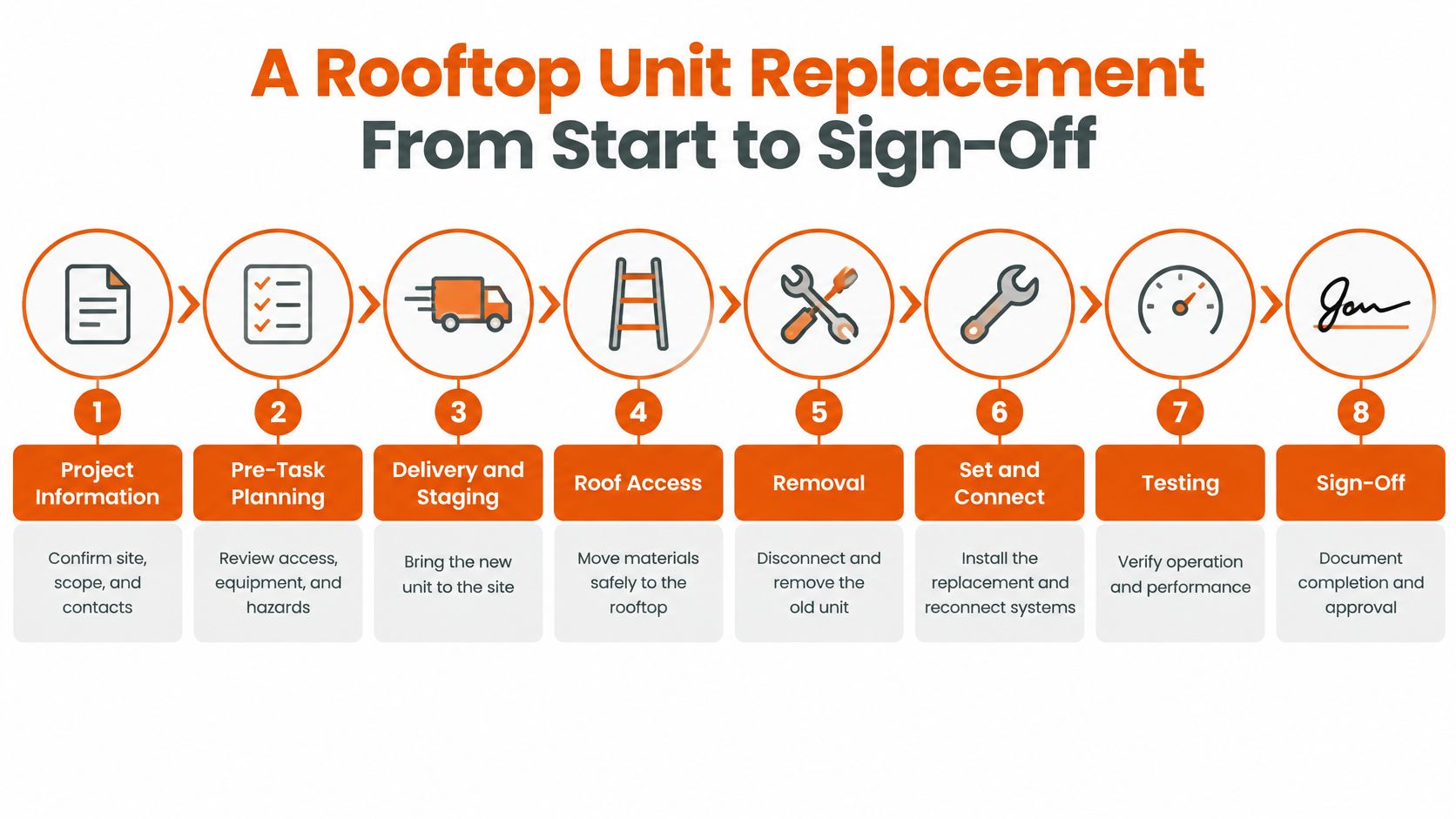
Filling in the front of the plan
Project information first: address, GC contact, start date, a crew of six, the site safety representative, the foreman, and the nearest hospital with the route written out. Then site conditions. Roof access is a fixed ladder from a mechanical mezzanine, the roof is fully membrane-covered, and the unit sits about 30 feet from the parapet. Temporary power comes from a panel the GC controls. Below the pick zone is a finished parking lot that stays open.
The task list follows the sequence: crane lift, curb installation, refrigerant recovery, brazing, penetrations, disconnect and reconnect.
Hazards, controls and the standards behind them
The lift is an overhead and struck-by hazard, so the control is an exclusion zone with barricade and a spotter, run under the crane and rigging requirements of 29 CFR 1926 Subpart CC. The brazing is hot work with membrane roofing underfoot, so it gets a hot work permit, a fire watch during and after the work, and a fire extinguisher at the point of operation, per Subpart J and the fire prevention requirements of Subpart F. The disconnect is energized work, so it gets lockout/tagout applied by the electrician and verified before the cover comes off, per Subpart K.
Nothing exotic. The value is that each control has a standard, a name and a verification step attached to it.
The morning of the lift and the change that follows
Before the pick, the foreman runs the pre-task review with all six workers and anyone else on the roof. They hear the exclusion zone, the signal person, the wind limit, and who verifies the barricade. They sign acknowledgment. Work starts.
Two hours in, the crane operator reports the original crane is down and the GC sends a smaller one. Here's where the plan earns or loses its credibility: the lift entry gets amended, with the new capacity, the new radius and the new pick plan, and the crew gets briefed on it before the unit goes up. A smaller crane means a longer boom at a steeper angle and a different swing path over the parking lot.
The plan changed because the work changed. That single habit, amending before proceeding rather than after, is the whole discipline in miniature.
Review the Plan Before Your Crew Mobilizes
A plan is accurate on the day it's reviewed and drifts from that moment on. The U.S. Occupational Safety and Health Administration investigated 826 worker deaths in fiscal year 2024, down 11% from 928 the previous fiscal year. Enforcement finds the failures after the fact. Review finds them before.
| Trigger | Required action | Who signs off |
|---|---|---|
| Crew or trade change | Update the crew list, training records and task assignments | Foreman and employer |
| New lift, energized or hot work | Amend the task hazard analysis and controls before work starts | Competent person and employer |
| Weather, access or site layout change | Reassess conditions and update the site section | Foreman |
| Another trade starts simultaneous work | Review interfaces and coordinate with the general contractor | Site safety representative |
| Incident or near miss | Investigate, update the affected task entry and brief the crew | Employer |
| Scheduled periodic review | Compare the plan with actual work and record the revision | Employer |
Four checks before anyone starts
- Confirm the plan matches the tasks scheduled, including the second and third week.
- Walk the site and verify each control physically exists, guardrail to barricade to lockout tag.
- Brief the crew and collect acknowledgment signatures.
- Post the emergency information, assembly point and hospital route where the crew will see it.
The plan's content is the employer's responsibility, and so is confirming it reflects the site, the current tasks and every legal and contract requirement. Approve against the site, never against the template. SiteSafetyPack assembles site-specific plans by asking the job questions, letting you review the draft, and issuing it as an editable Word file and a PDF, and a completeness check flags what's missing before anyone signs.
SiteSafetyPack builds site-specific safety plans for HVAC, plumbing and electrical subcontractors, turning your answers about the job into tasks, hazards, controls and the standards behind each one, ready for your review and download in Word and PDF. You can build a plan and preview it free, so you can see whether the structure matches the job your crew is walking into before you spend anything. Visit SiteSafetyPack to start the plan for your next project.