Electrical Safety Program: What a Written Plan Must Cover
Learn what a written electrical safety program must include: hazards, training, energized work, responsibilities and inspections, with a checklist.

Seventy-one construction workers died from electrocution in 2017, almost 8% of that year's construction fatalities, according to Bureau of Labor Statistics figures cited in OSHA's Electrical Hazards in Construction presentation. A written electrical safety program has to address that consequence, not just demonstrate that someone prepared a binder.
For a site manager, the practical test is straightforward: can the foreman connect every safety rule to something the crew checks before starting work? A policy that says to isolate equipment means little unless someone can identify the correct disconnect, verify the work location and produce a record of the checks.
Why Electrical Safety Needs a Written Program
A general instruction to work safely around electricity doesn't resolve an unlabeled panel, an uncertain feeder or a damaged temporary cord crossing a walkway. Each situation requires a different decision, a person authorized to make it and a way to confirm the control worked.
The written program establishes those arrangements before schedule pressure reaches the crew. It should describe which activities the company performs, which electrical hazards those activities create and how supervisors authorize workers for them. It also needs to distinguish standing company rules from job-specific information that changes with each site.
Turn policy into an observable check
Consider a plumbing crew drilling anchors near an existing electrical room. Their electrical exposure isn't the same as an electrician testing a switchboard, but their pre-task planning still needs to identify concealed services, adjacent energized equipment and the limits of their authorization.
A useful program connects:
- The task: What the crew will install, remove, test or access.
- The hazard: Where electrical energy could reach a person, tool or piece of equipment.
- The control: What must happen before the task proceeds.
- The evidence: What the foreman records or demonstrates at the work location.
Practical rule: If a foreman can't describe how the crew checks a requirement, rewrite it as an action rather than an aspiration.
Paperwork alone fails when supervisors mistake a completed form for a completed control. A checked box saying equipment inspected doesn't establish which equipment was inspected, what defect was found or whether anyone removed it from service.
The program needs enough detail to guide boundaries, training, isolation, decision ownership and review without burying the crew in unrelated procedures. Its value comes from the decisions people can make with it at the job.
Required Elements of a Written Electrical Safety Program
Use this checklist to connect each program element to a jobsite question and a record the foreman can produce.
| Element | What It Must Answer | Field Evidence |
|---|---|---|
| Scope and responsibilities | Who writes, approves and enforces the program | Named roles with signed acceptance |
| Hazard identification | Which energized parts, utilities and temporary power exist at this site | Pre-task hazard analysis for the job |
| Training and qualification | Who is qualified for which task and how that is proven | Training roster and qualification records |
| Energized work | When live work is allowed and who authorizes it | Signed energized-work permit with approvals |
| Lockout/tagout | How energy is isolated, locked and verified at zero | Lock and tag log with absence-of-voltage test record |
| Work practices and approach distances | Clearances, tools, PPE and grounding rules | PPE hazard assessment and task checklist |
| Inspections and tool checks | How equipment condition is confirmed before use | Inspection log with dates and defects found |
| Emergency response | How a shock or arc event is reported and rescued | Site emergency plan reviewed at job start |
| Incident investigation and revision | What changes after an incident or new site condition | Incident report and revision log |
Treat this as a program-design checklist, not a claim that every listed form is universally required under the same regulation. The employer must establish the requirements applicable to its work, jurisdiction and equipment.
A row is complete only when the field practice supports the policy. For inspections, that means a record tied to identifiable equipment and a disposition for defects, not a blank form filed behind an inspection heading.
Close the authorization gap
Energized-work authorization needs more than an instruction to obtain permission. Define who evaluates the justification, who approves the method and what information they need before approval. The approval process must allow refusal when the exposure hasn't been established or the proposed controls aren't adequate.
Separate that technical decision from production approval. A general contractor's request to keep equipment operating doesn't establish that a particular electrical work method is acceptable.
Make hazard identification site-specific
A generic hazard list might mention electrical shock without identifying the service panel beside the work, the temporary distribution board or the buried supply crossing the excavation. Require equipment identifiers, locations and interfaces with other trades.
An electrical subcontractor's program may emphasize testing and isolation. A multi-trade contractor also needs clear arrangements for shared temporary power, access restrictions and coordination when one crew changes conditions for another. A construction safety program framework can organize those company-wide responsibilities without replacing the job-specific assessment.
Choose a small selection of rows and ask whether the foreman could produce the evidence within an hour of an inspector asking. Missing records identify where to investigate; records that don't match the site identify a more serious implementation gap.
Setting Arc Flash and Shock Boundaries
A shock boundary is like a fence that keeps a hand away from a wire. An arc-flash boundary is more like a distance from a fire: thermal energy can injure someone without direct contact with the energized part.
The visual distinction helps crews avoid treating these as interchangeable controls.
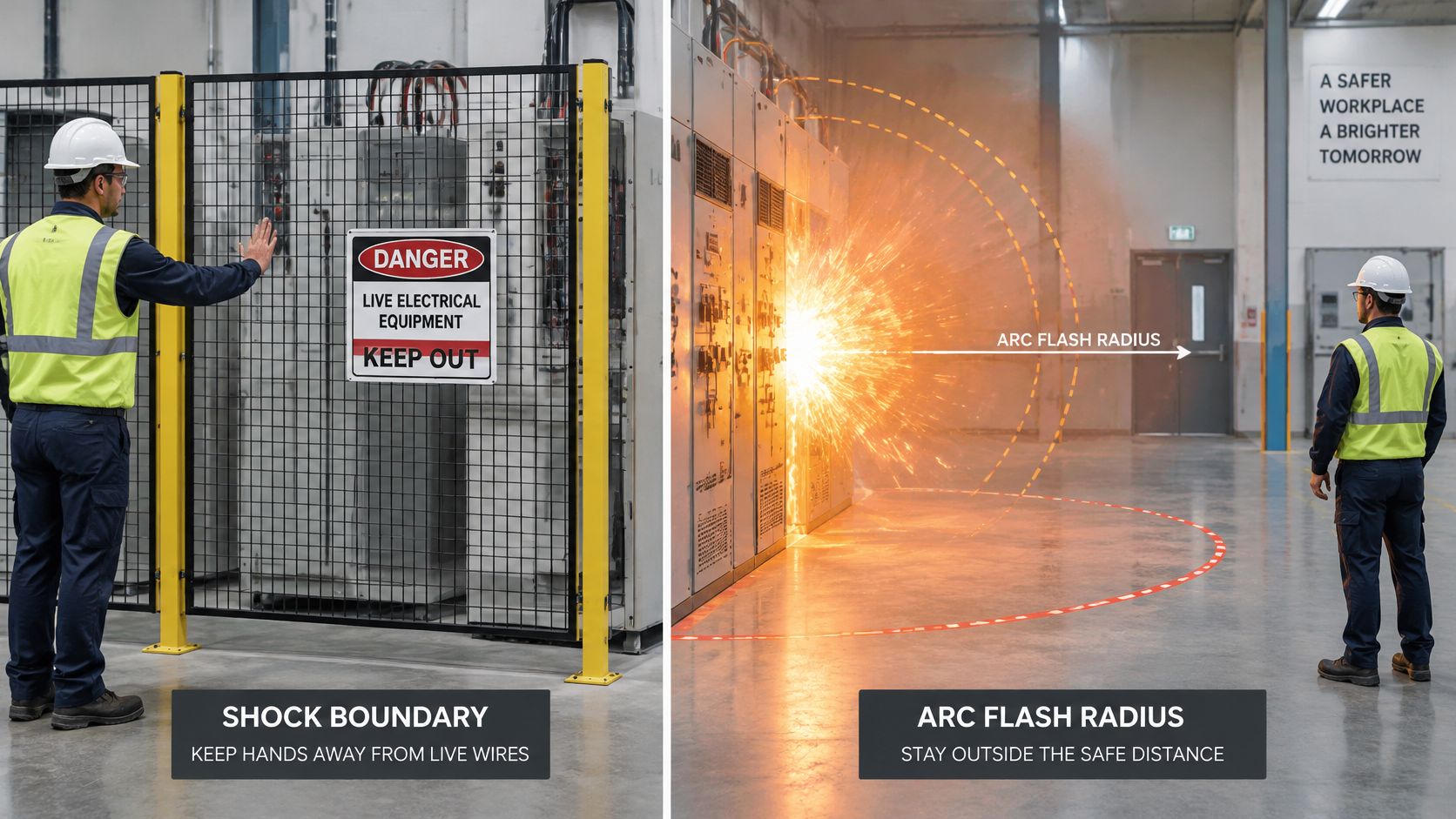
The arc-flash reference threshold is 1.2 cal/cm² (5.02 J/cm²), while limited and restricted approach boundaries address shock exposure separately, as described in the electrical safety guidance summarized by NIOSH's electrocution prevention bulletin. That energy threshold isn't a universal distance to tape onto the floor.
| Boundary | Protects Against | Reference Value |
|---|---|---|
| Arc-flash boundary | Thermal energy from an arc | Distance at the incident-energy threshold stated above, established for the equipment and task |
| Limited approach boundary | Shock exposure, including approach by unqualified persons | Applicable distance selected for the nominal voltage and exposure conditions |
| Restricted approach boundary | Shock exposure during close approach by qualified persons | Applicable distance selected for the nominal voltage and exposure conditions |
Record the basis, not just the barrier
The energized-work plan should identify the qualified personnel, separate boundary distances, approach controls, incident-energy basis and PPE selected for the established exposure. The foreman needs to know which assessment supports the setup, not merely that someone placed cones nearby.
Arc-rated clothing can't prevent a worker from contacting a live conductor. Keeping a worker outside a shock approach distance doesn't, by itself, establish adequate protection from arc thermal energy.
Missing labels or an unavailable study don't establish low risk. Pause the task and have a competent technical evaluator establish the applicable exposure and controls; don't substitute an arbitrary PPE selection for missing information.
Use this video alongside the equipment-specific briefing, not instead of it.
The same work plan should account for tool condition, grounding continuity and nearby overhead or underground utilities. Record where the crew will stand and move, including how tools, ladders and materials could cross a boundary.
A boundary is useful only when the crew can identify it at the work location and explain who may cross it.
Training Matched to Each Worker's Exposure
A driving-licence system distinguishes between a learner and someone authorized to operate a commercial vehicle. Electrical qualification needs the same task-specific thinking: attendance at a general orientation doesn't authorize every kind of electrical work.
This comparison is useful when explaining why crew members need different training.
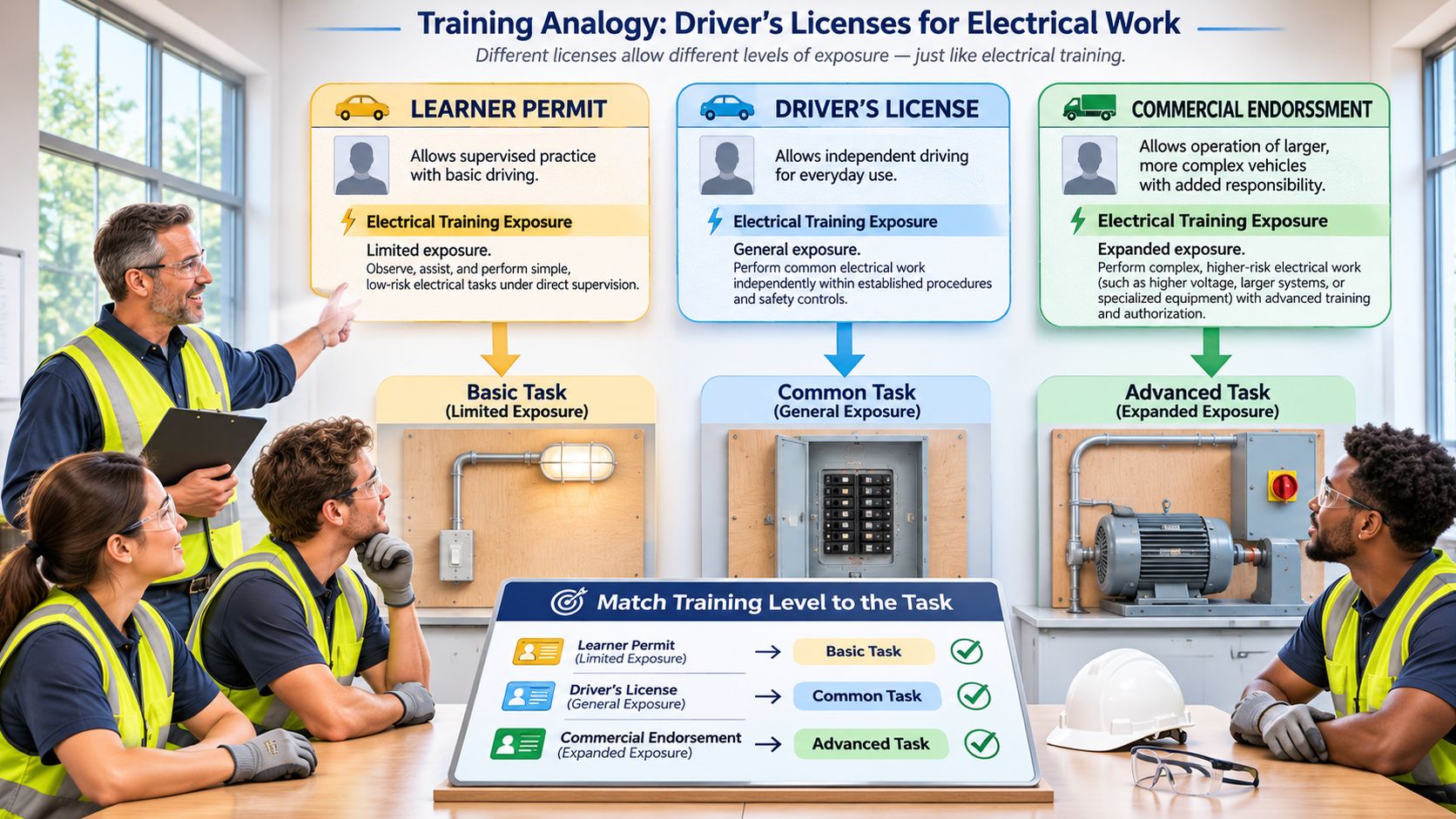
Under OSHA's electrical safety training standard, training addresses the work practices relevant to an employee's assignment when the installation hasn't eliminated the shock risk. Qualified persons need the skills to distinguish live parts, determine nominal voltage and apply required clearance distances, with additional training for relevant tool and material contact hazards.
Unqualified workers still need electrical-hazard instruction appropriate to their tasks. That includes recognizing situations they must not enter or attempt to resolve themselves.
Build a task authorization matrix
Start with work activities rather than job titles. List panel installation, temporary power, testing and work near existing services separately, then identify the exposure and competence each activity demands.
| Task | Worker Classification and Voltage Exposure | Supervision and Qualification Evidence |
|---|---|---|
| Pulling cable near an energized switchboard | Unqualified helper, adjacent energized equipment identified by nominal voltage | Remain outside applicable approach boundaries, receive a documented briefing and work under a qualified person's direction |
| Absence-of-voltage testing | Person qualified for the equipment, test method and identified voltage | Documented instruction and demonstrated practical ability with the selected tester |
| Using temporary power | Worker trained for use, not authorized to access exposed energized parts | Briefing on inspection, defects, protective arrangements and reporting |
For the helper, direction from a qualified person doesn't turn the helper into a qualified electrician. If the cable route would bring the helper, cable or tools into a prohibited exposure, change the route or establish a safe work condition before proceeding.
Verify learning, not attendance
For each row, name the applicable training requirements and the person who evaluates competence. Keep classroom or on-the-job records, but also document the worker's ability to perform the assigned checks.
In Plant Services' 2025 electrical-safety survey, 47.8% of respondents had received no NFPA 70E training. That finding is a reason to verify training coverage, not to assume that one course alone qualifies someone for every task.
The task sets the hazard, the hazard sets the skill requirement, and the qualification record establishes the worker's authorization.
How to Confirm Equipment Is Dead Before Work Starts
For specialty contractors, isolation verification belongs in pre-task planning, not in a last-minute conversation beside the panel. CDC's occupational electrical injury analysis recorded 524 fatal electrical injuries among specialty trade contractors during 2011–2020, representing 71.1% of construction's total.
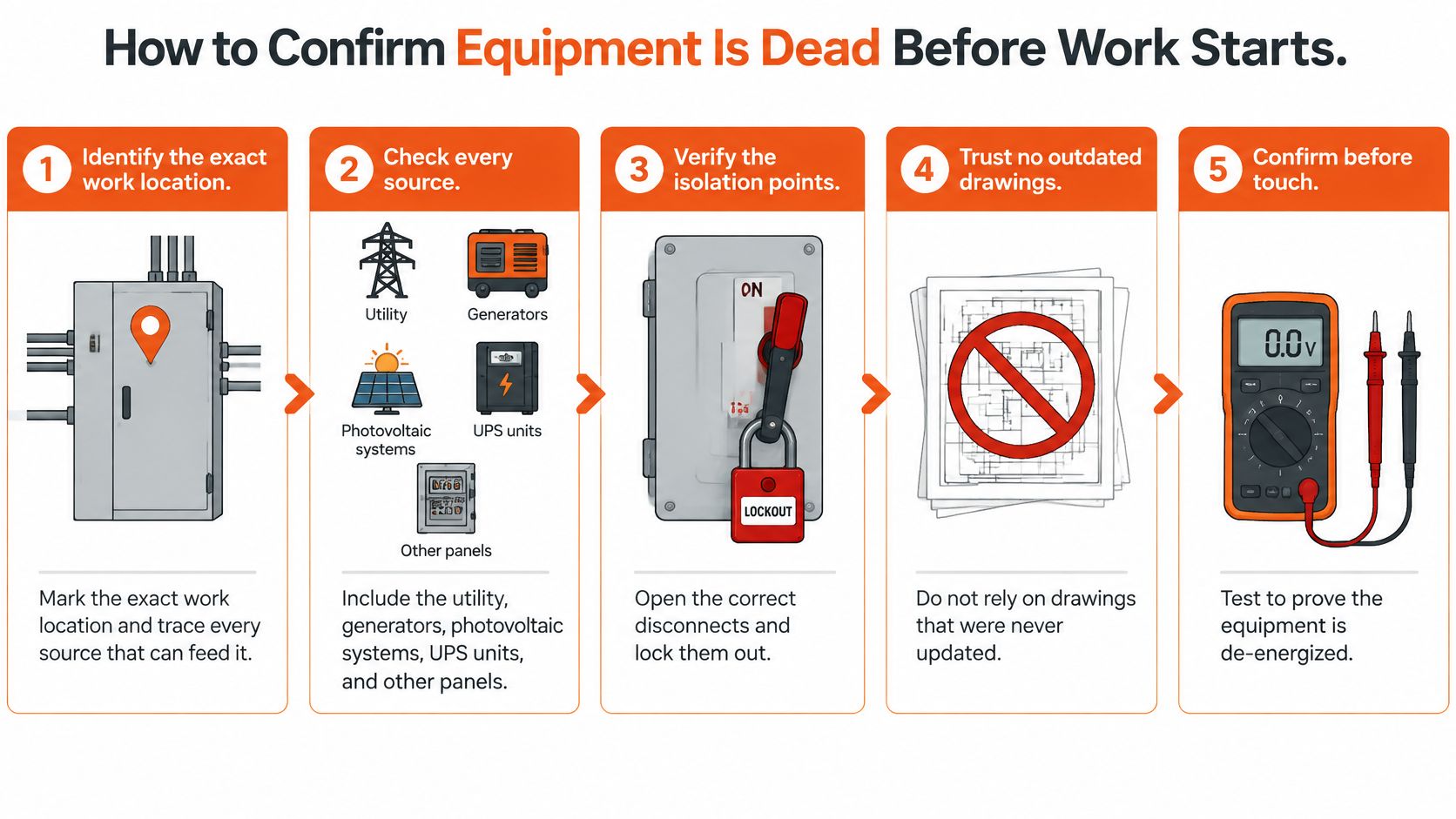
The following visual provides an overview; the written procedure must carry the complete sequence.
Follow the source-to-work-point sequence
Identify the exact work location and every supply. Trace utility power, generators, photovoltaic systems, UPS units and connections from other panels. The common slip is trusting drawings without checking whether they represent the installed system.
Investigate backfeed paths. Confirm how alternate supplies and interconnected equipment could energize the work location. Opening the expected breaker doesn't prove that every supply path has been interrupted.
Isolate, lock and tag each source. Use the equipment-specific procedure and record the isolation points and lock holders. Treat equipment as energized until the complete protective process has been verified, not merely because a handle is in the off position.
Verify absence of voltage at the point of work. A qualified person uses properly rated test equipment, verifies the tester on a known source before and after testing, and checks the relevant conductors and combinations. Testing a convenient upstream location doesn't establish the condition where someone will touch the equipment.
Resolve emergency and life-safety arrangements. Identify affected emergency loads, shutoff methods and whether a CPR-trained standby person is needed. Don't leave those decisions until after equipment has been disconnected.
Define stop-and-reassess conditions. An unidentified conductor, changed scope, wet conditions or a crew change should trigger a controlled pause and revalidation of the applicable checks. A handover isn't permission to assume the previous crew's work condition remains unchanged.
Route necessary energized work through the exception process. If the planned isolation can't be completed, stop and obtain the required technical review and authorization. The crew shouldn't improvise a live-work method to preserve the schedule.
The University of Vermont's electrical safety program illustrates why backfeeds, exact work locations, emergency shutoffs and standby arrangements belong in a practical decision path. Keep panel photographs, identification labels, isolation records and test-before/test-after results tied to that location.
Check external supplies before equipment moves
Before lifts, excavation or mast work, obtain reliable powerline identification and voltage information from the utility or an appropriately qualified person. In its 2024 construction electrical safety evaluation, SafeWork NSW found that 48% of persons conducting a business or undertaking didn't identify nearby powerline voltage to establish appropriate controls.
A signed permit records authorization. It doesn't prove that the crew isolated the correct circuit.
Who Holds Which Decision on Site
Electrical safety isn't a worker-only training problem. Supervisors choose methods, general contractors coordinate access, equipment operators move near utilities and helpers encounter hazards they may not recognize.
A systematic review of electrical competency interventions found that only 2 of 25 identified interventions addressed system levels beyond the worker, and it described the evidence quality as low. The practical implication is to examine management decisions as well as individual knowledge.
Assign decisions to named people
Use actual names on the job assignment sheet, with an alternate when the primary person is unavailable.
- Energized-work method: A designated technical authority evaluates the method and approves or rejects it within the employer's authorization process.
- Isolation verification: The assigned qualified person confirms the work condition and records the verification.
- Exclusion-zone control: A named foreman or attendant manages access and coordinates interference from other trades.
- Adjacent and concealed hazards: The pre-task lead identifies unresolved services and obtains qualified assistance before releasing the work.
- Change communication: The site supervisor stops affected activities and briefs everyone whose work conditions have changed.
- Emergency response: Designated responders follow the rescue plan without entering an uncontrolled electrical exposure.
A safety and health program sample can help organize responsibility assignments, but the employer still needs to determine whether each named person can perform the assigned function.
Test the difficult decisions
Licensing, training completion and PPE issuance are evidence to consider, not interchangeable proof of competence. A licensed person can still make an unsafe assumption about an unlabeled panel.
Use scenario-based assessments: conflicting drawings, a wet work location, simultaneous trades or pressure to restore service. Ask the supervisor what would stop work, who would resolve the uncertainty and what evidence would support restarting.
For helpers and operators, test recognition and escalation rather than electrical troubleshooting. A good response may be to stop movement, maintain separation and contact the designated supervisor.
Virtual reality and social-learning methods offer ways to practise rare, high-consequence situations, but implementation evidence is still developing. Use them to supplement practical demonstration and field verification, not replace them.
Check Your Program Against Your Next Job
Review the program when equipment changes, a new site begins, drawings are revised, another trade joins the work, or a near miss or incident reveals a weakness. Don't wait for a scheduled review if the crew's actual exposure has changed.
Keep the inspection log, training roster, toolbox talk record and revision log connected by job and task identifiers. Together, they should show what changed, who received the information and who approved the resulting work arrangements.
Run the pre-job check
- Match the training matrix to the crew list. Confirm each person's classification and authorization for the assigned work, including substitutes and helpers.
- Check the electrical work package. Where applicable, confirm energized-work permits have the supporting panel photographs and verification records appropriate to the task; planned isolation records must be completed through field verification before work begins.
- Confirm emergency readiness. Keep site emergency information at the job and review it with the crew at the start, including access instructions, emergency contacts and shutdown arrangements.
Keep company procedures distinct from the construction project safety plan. The company program establishes how the employer manages electrical safety; the project plan identifies the hazards and arrangements for that location.
At SiteSafetyPack, we offer adaptable program documents including a job hazard analysis, training roster, toolbox talk record, inspection log and revision log, but drafts require employer review and don't replace legal or safety-compliance advice.
Pick the highest-risk electrical task on the next job and prepare its isolation record before mobilization. Identify the equipment, sources, responsible people and unresolved questions, leaving actual field verification results to be recorded when performed. Don't release that task until the foreman can show that the planned controls match the installed conditions.
Visit SiteSafetyPack to read a full sample program for a fictional electrical contractor before buying and assess whether its structure fits your work. Our electrical safety plans cover power, lighting, low-voltage and temporary power, with editable documents you can review against the next job's actual hazards.